
Form 8832 changes your LLC’s tax classification — to a C corporation, a partnership, or a disregarded entity — while Form 2553 elects S corporation status. Most LLCs that want S-corp treatment only file Form 2553: a timely 2553 triggers a deemed election to be classified as a corporation, so no separate 8832 is needed. And one hard rule decides many cases before you start: nonresident aliens cannot be S-corp shareholders, so a foreign-owned LLC can never elect S-corp status.
What Is Form 8832?
Form 8832, the Entity Classification Election, is the IRS form that lets an eligible entity override its default tax classification under the check-the-box regulations. A single-member LLC defaults to disregarded entity; a multi-member LLC defaults to partnership. Form 8832 lets you elect a different treatment — most commonly, to be taxed as a C corporation. Form 8832 only gets you to C corporation status. It does not, by itself, give you S corporation treatment.
What Is Form 2553?
Form 2553, the Election by a Small Business Corporation, is how an entity that already qualifies as a corporation elects S corporation treatment under Subchapter S. S-corp status keeps income flowing through to the owners while changing how owners are paid — a reasonable salary plus distributions, instead of all income as self-employment income. An LLC files Form 2553 to become an S-corp; the IRS treats a timely 2553 as also electing corporate classification, which is the deemed-election rule.
The Deemed Election: Why You Usually File Only One Form
Under Treasury Regulation 301.7701-3(c)(1)(v)(C), an eligible LLC that timely files Form 2553 is automatically treated as having elected to be classified as a corporation. The deemed election takes effect on the same date as the S corporation election and stays in place until the entity makes a valid election to be classified as something else. Do not file Form 8832 when electing S-corp via a timely Form 2553 — the extra form adds nothing and can create a conflicting record. You need Form 8832 as well only in specific cases, such as when the 2553 is late and you are seeking late relief.
Deadlines: 75 Days vs 2 Months and 15 Days
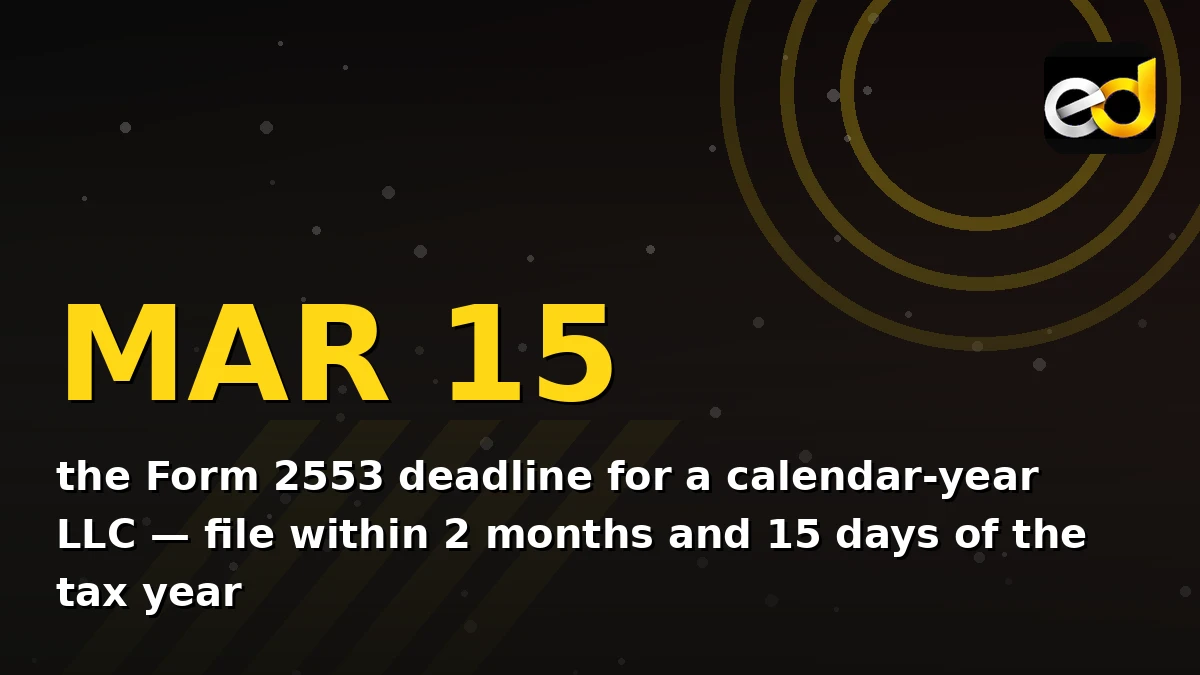
Form 2553 has a hard deadline: it is due no more than 2 months and 15 days after the beginning of the tax year it should take effect, or at any time during the preceding tax year. For a calendar-year LLC that means March 15. Miss it and the election takes effect the following tax year, unless late relief is granted. Form 8832 has no single deadline, but a flexible window: the effective date you choose cannot be more than 75 days before the date you file, and cannot be more than 12 months after the filing date. Want an election retroactive by more than 75 days? You need late election relief.
Late Relief If You Miss the Deadline
Missing a deadline does not permanently lock you out. For a late Form 2553, Revenue Procedure 2013-30 provides simplified relief if less than 3 years and 75 days have passed since the date the election was supposed to take effect, the entity was otherwise eligible, and its returns were filed consistently with S-corp status. For a late Form 8832, Revenue Procedure 2009-41 provides similar relief within 3 years and 75 days of the requested effective date, with returns consistent with the requested classification. In both cases relief is a request, not a right — file promptly and keep your returns consistent.
Which Election Fits Your LLC?
If you are a non-resident owner, the choice is made for you: S-corp status is barred, so Form 2553 is off the table and Form 8832 is your only election — typically to be taxed as a C corporation, which then files Form 1120 and a pro forma return with Form 5472. If you are a US-resident owner with meaningful profit above a reasonable salary, S-corp status via Form 2553 can cut self-employment tax — the classic break-even point is often cited around $60,000 of net profit. If you want C-corp treatment without S-corp rules, file Form 8832 alone. And remember the 60-month rule: once you change classification by election on Form 8832, you generally cannot change it again by election for 60 months after the effective date.
Related: LLC vs C-Corp for Non-Residents: Which Entity Wins in 2026
Related: Single-Member vs Multi-Member LLC: Tax Differences Owners Must Know (2026)
Related: How to Pay Yourself from a US LLC as a Non-Resident (2026)
Frequently Asked Questions
Do I need to file both Form 8832 and Form 2553 to become an S-corp?
Usually no. A timely Form 2553 alone is enough — the IRS treats it as also electing corporate classification. File both only when the 2553 is late and you are seeking relief.
What is the Form 2553 deadline?
No more than 2 months and 15 days after the tax year begins — March 15 for a calendar-year LLC — or any time during the preceding tax year.
How far back can Form 8832 reach?
The effective date cannot be more than 75 days before the filing date, or more than 12 months after it. Anything further back needs late election relief.
Can a non-resident LLC owner elect S-corp status?
No. Nonresident aliens cannot be S corporation shareholders, so a foreign-owned LLC can never file Form 2553. Form 8832 to C-corp status is the available election.
How long am I locked in after an 8832 election?
Generally 60 months from the effective date before you can change classification again by election.
Free: US LLC Compliance Checklist
Subscribe and get the checklist instantly — plus our daily roundup: the 5 newest articles in one short email. Max 1 email a day.