

Form 1116 is the IRS form that claims the foreign tax credit — it reduces your US income tax dollar for dollar by the income tax you paid to another country, but only up to the US tax on that same foreign-source income. Any foreign tax above that limit does not disappear: it carries back 1 year and forward 10 years.
What Is the Foreign Tax Credit?
The foreign tax credit is a US tax credit that subtracts qualifying foreign income tax from your US income tax, dollar for dollar, whether or not you itemize. A credit is worth more than a deduction: a $1,000 credit cuts your tax bill by $1,000, while a $1,000 deduction only cuts it by your tax rate on $1,000. You must choose one or the other for all your foreign taxes in a given year — you cannot credit some and deduct others — but you can switch from a deduction to a credit for up to 10 years.
Who Can Claim the Foreign Tax Credit?
US citizens and US resident aliens claim it on Form 1116 attached to Form 1040. For LLC owners this matters most when you are a US citizen or resident living abroad, or a resident alien with a US LLC: you pay tax abroad on the same income and use Form 1116 so the US does not tax it again. Nonresident aliens generally cannot claim the credit — so a non-resident owner filing Form 1040-NR for a single-member LLC does not use Form 1116, and should not expect a credit for tax paid at home. Dual-status filers and resident aliens who elect to be treated as residents can claim it for the resident part of the year.
How Is the Credit Limit Figured?
The credit is capped at the US tax on your foreign-source income: US tax before credits multiplied by foreign-source taxable income divided by worldwide taxable income. Worked example: if your US tax before credits is $12,000 and half your taxable income is foreign-source, your limit is $6,000 — even if you paid $9,000 of foreign tax. The remaining $3,000 is not lost; it becomes a carryover. You file a separate Form 1116 for each income category — general category income (business and wages) and passive category income (dividends and interest) each get their own limit, and excess credit in one category cannot offset US tax in another.
What Happens to Foreign Tax Over the Limit?
Under IRC 904(c), foreign tax over the limit in a category is treated as paid first in the immediately preceding tax year, then in each of the next 10 tax years, in that order — and only to the extent that year’s limit has room. A carryback is claimed on an amended return (Form 1040-X) with a revised Form 1116, and Schedule B of Form 1116 tracks the carryover balance by category. Credits that are not used within the 10-year carryforward window expire permanently, so the oldest vintage matters first.
When Can You Skip Form 1116?
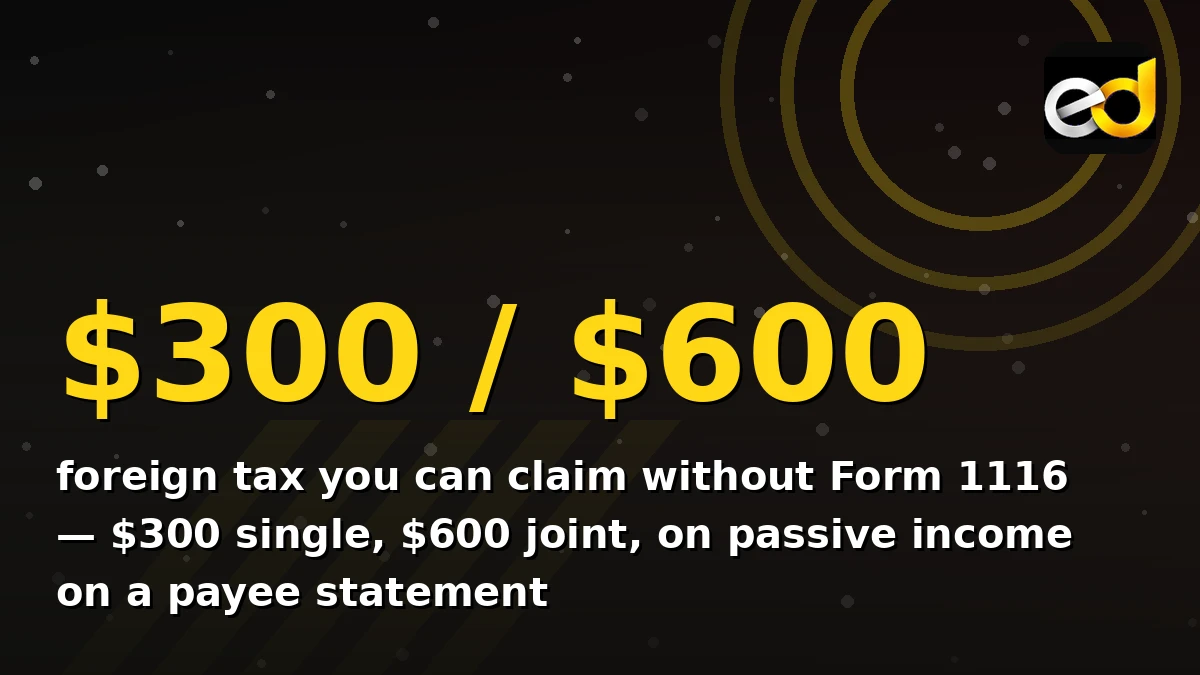
If all your foreign income is passive income such as dividends or interest, it is reported to you on a payee statement such as Form 1099-DIV, and the total foreign tax is $300 or less ($600 if married filing jointly), you can claim the credit directly on Schedule 3, line 1 — no Form 1116 needed. The trade-off is that you cannot carry any unused credit to or from a year in which you use this election, so it only makes sense for small amounts you expect to use in full.
What the Credit Does Not Do
The foreign tax credit does not reduce self-employment tax — the 15.3% SE tax on net self-employment income of $400 or more still applies in full. It does not cover tax on income you excluded under the foreign earned income exclusion (Form 2555): you cannot claim a credit on the same dollars you already excluded. And it only covers income taxes — foreign sales tax, VAT, property tax and social security taxes do not count.
Related: LLC for US Residents vs Non-Residents: What’s Actually Different (2026) — https://epicsdeals.com/llc-us-residents-vs-non-residents-2026/
Related: How to Pay Yourself from a US LLC as a Non-Resident (2026) — https://epicsdeals.com/how-to-pay-yourself-us-llc-non-resident-2026/
Related: Single-Member vs Multi-Member LLC: Tax Differences Owners Must Know (2026) — https://epicsdeals.com/single-member-vs-multi-member-llc-tax-differences-owners-must-know-2026/
Frequently Asked Questions
Can a non-resident LLC owner claim the foreign tax credit?
Generally no. Nonresident aliens filing Form 1040-NR cannot claim the foreign tax credit. It is for US citizens, resident aliens and dual-status filers.
How much foreign tax credit can I claim?
Up to the US tax on your foreign-source income — US tax before credits times your foreign share of taxable income. Anything above that carries back 1 year and forward 10 years.
Do I need Form 1116 for a small amount of foreign tax?
Not always. If all your foreign income is passive, reported on a payee statement, and the tax is $300 or less ($600 joint), you can claim it on Schedule 3 without Form 1116.
Can I claim the credit and the foreign earned income exclusion together?
Only on different income. You cannot claim a foreign tax credit on income you already excluded with Form 2555 — the same dollars cannot be both excluded and credited.
Does the foreign tax credit reduce self-employment tax?
No. The credit only reduces income tax. The 15.3% self-employment tax still applies to net self-employment income of $400 or more.
Free: US LLC Compliance Checklist
Subscribe and get the checklist instantly — plus our daily roundup: the 5 newest articles in one short email. Max 1 email a day.